
| Review | Yunlong International Workshop on Vernacular Heritage |
| PublishDate:2026-01-04 Hits:4891 |
|
From October 11 to 22, 2025, the Yunlong International Workshop on Tangible and Intangible Culture of Vernacular Heritage 2025 was successfully held in Yunlong County, Dali Bai Autonomous Prefecture, Yunnan Province. The workshop was hosted by Tongji University, World Heritage Institute of Training and Research for the Asia and the Pacific Region under the Auspices of UNESCO (WHITR-AP), International Committee for Vernacular Architecture, ICOMOS (ICOMOS-CIAV), International Committee on Intangible Cultural Heritage, ICOMOS (ICOMOS-ICICH), and organized by World Heritage lnstitute of Training and Research for the Asia and the Pacific Region under the Auspices of UNESCO, Shanghai Centre (WHITR-AP Shanghai), College of Architecture and Urban Planning, Tongji University, Tongji-Dali Heritage Conservation and Cultural Innovation Institute, Yunlong County, Dali Bai Autonomous Prefecture, Yunnan Province, with support provided by Shanghai Tongji Urban Planning and Design Institute Co., Ltd., the National Foreign Expert Program(Category H), Tongji University Key Foreign Expert Recruitment Program, 2025 Tongji University Europe-America International Student Summer School Program. The workshop aimed to explore innovative approaches to conserving cultural ecosystems by integrating the protection of tangible and intangible cultural heritage. Taking Yunlong and its rich salt heritage, this workshop tried to explore the integration of UNESCO’s Convention Concerning the Protection of the World Cultural and Natural Heritage (1972) and the Convention for the Safeguarding of the Intangible Cultural Heritage (2003), and also marked an important step toward strengthening international cooperation in the conservation of vernacular heritage and contributed to improving the international academic community’s understanding of the value of China’s vernacular heritage.
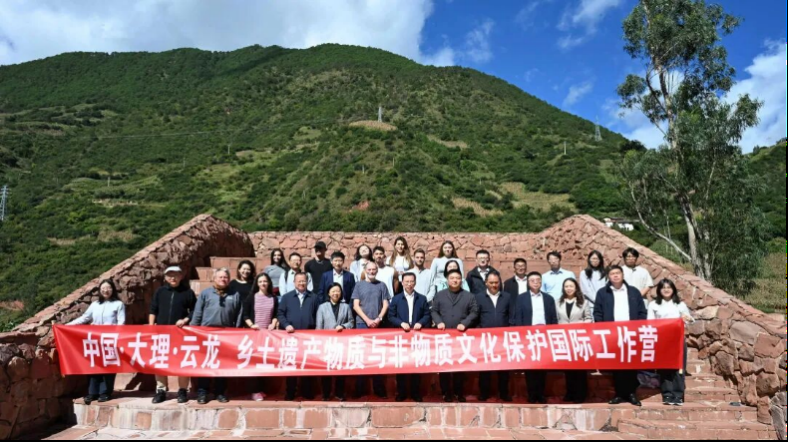
Photo at the opening ceremony
Workshop Preparation and Opening
The preparation for the workshop began in July 2024, included preliminary research and a series of consultations with international experts and specialists from ICOMOS-CIAV and ICOMOS-ICICH. Participant recruitment commenced on May 8, 2025, and attracted 88 applications from four continents. 17 students from six countries were selected, including master’s and doctoral students in architecture, urban and rural planning, and cultural heritage conservation from China, Indonesia, France, Portugal, Finland, and Spain.
The expert team consisted of 12 experts and scholars representing nine national and international heritage conservation organizations, academic institutions, and universities. These included ICOMOS-CIAV, ICOMOS-ICICH, the International Scientific Committee of Earthen Architectural Heritage, ICOMOS (ICOMOS-ISCEAH), the International Centre for the Study of the Preservation and Restoration of Cultural Property (ICCROM), Peking University, Huazhong University of Science and Technology, Kunming University of Science and Technology, Yunnan University, and Tongji University, collectively covering expertise in both tangible and intangible cultural heritage conservation. (https://mp.weixin.qq.com/s/-yYWK1HJdtn5yy_dFSG9cA)
Domestic and international experts participating in the workshop
On October 11, 2025, workshop participants arrived in Yunlong. On the morning of October 13, the opening ceremony was held at Yong’an School in Yong’an Village, Yunlong County. The ceremony was attended by Professor Zheng Qinghua, Secretary of the Party Committee of Tongji University and Academician of the Chinese Academy of Engineering; Mr. Gisle Jakhelln, former President of ICOMOS-CIAV; Professor Li Xiangning, Vice President of Tongji University; Mr. Wang Wu, Member of the Standing Committee of the Dali Prefecture Party Committee and Head of the Organization Department; Mr. Yang Guojun, Deputy Secretary of the Yunlong County Party Committee.
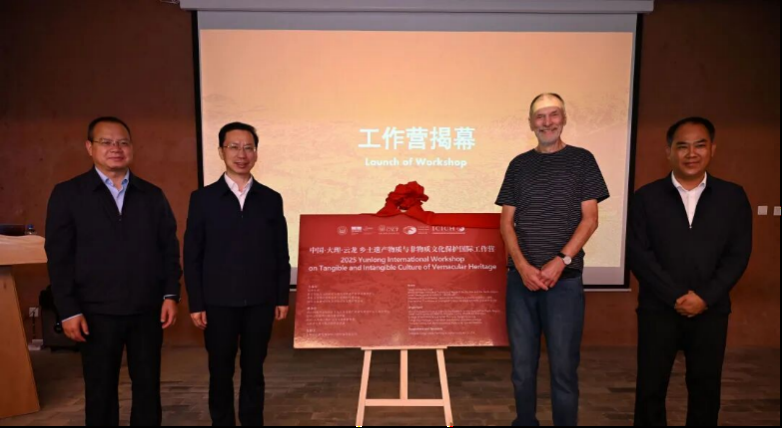
The opening ceremony was chaired by Shao Yong, Professor at the College of Architecture and Urban Planning at Tongji University, Secretary-General of WHITR-AP. Opening remarks were delivered by Deputy Secretary Yang Guojun, Mr. Gisle Jakhelln, and Vice President Li Xiangning. Prof. Li Xiangning reviewed the long-standing and in-depth cooperation between Yunlong County and Tongji University under the "pairing assistance" initiative. He expressed the hope that this workshop would foster cross-regional and cross-cultural exchange of ideas, encourage mutual learning, and introduce innovative perspectives to cultural heritage conservation in Yunlong, Dali, and beyond. Thereby contributing to the advancement of heritage conservation and sustainable development. At the end of the ceremony, Professor Shao Yong invited Prof. Zheng Qinghua, Mr. Gisle Jakhelln, Mr. Wang Wu, and Mr. Yang Guojun to jointly unveil the workshop board, formally marking its commencement.
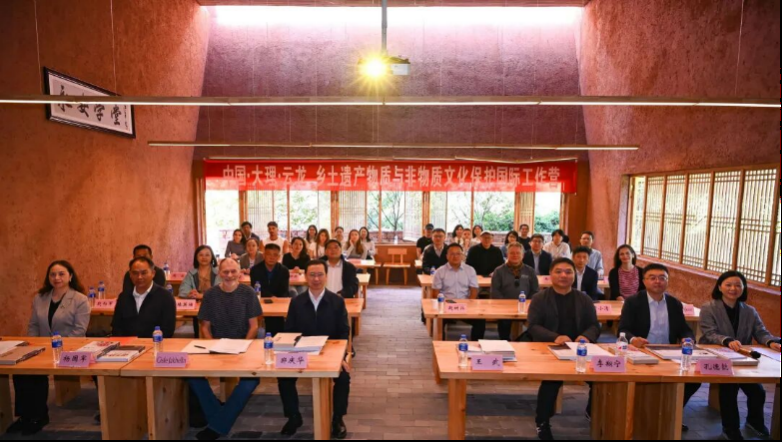 Opening Ceremony
Academic Lectures and Preliminary Research
From October 11 to 17, the workshop organized a series of thematic academic lectures. On October 12, Mr. Gisle Jakhelln introduced the objectives and framework of the workshop to all participants. Mr. Eivind Falk subsequently delivered a lecture on UNESCO’s Convention for the Safeguarding of the Intangible Cultural Heritage, drawing on conservation experiences from his past work in Norway and India. Complementing these international perspectives, Associate Professor Su Junjie from Yunnan University, a specialist in Chinese intangible cultural heritage conservation, presented conservation practices in Yunnan Province. His lecture enhanced participants’ understanding of the local cultural context and offered a critical reflection on current approaches to intangible heritage conservation in Yunnan.
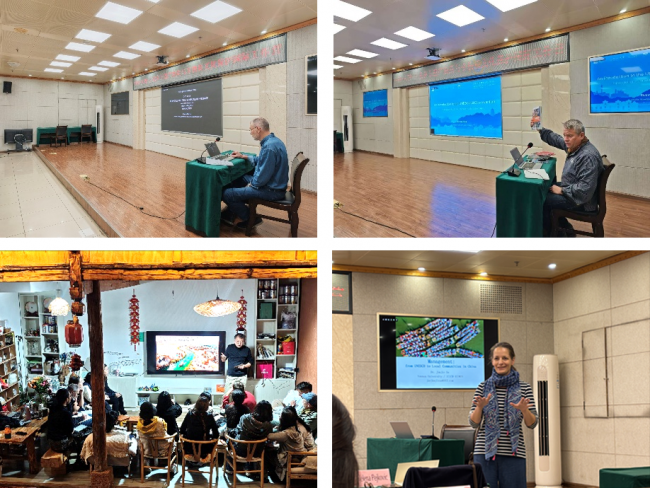 Academic Lectures
Between October 11 and 14, the workshop conducted field research on Yunlong’s salt culture system. Under the guidance of local guide, experts and students visited historic salt villages, including Nuodeng and Baofeng, investigated ancient salt wells such as Luoma Well and Nuodeng Well, dispersed salt stoves within ancient villages, as well as historic bridges and pathways, including Tongjing Bridge. Through observations of salt valleys, rivers, wells, stoves, villages, and transportation routes, participants developed an initial, integrated the basic understanding of Yunlong’s salt culture system.
Building on daily field research, the workshop arranged corresponding lectures to support systematic reflection on participants’ observations and analytical insight within a cultural heritage framework. Professor Sun Hua from Peking University presented a lecture on salt culture from an archaeological perspective, Professor Zhao Kui from Huazhong University of Science and Technology discussed salt culture and salt heritage in a global context, and Associate Professor Liu Yan from Kunming University of Science and Technology explained the construction techniques of wooden arch bridges in Yunlong.
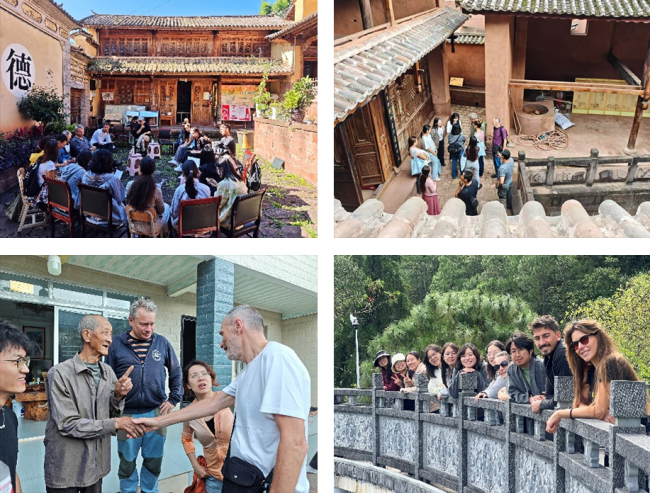 Experts and students conducting field research
Group Research and Output Development
After the preliminary research, student participants and experts were organized into four thematic groups, each focusing on a key component of the salt culture ecosystem structured around salt production: Salt wells, Salt stoves, Salt villages, and Salt trails. The salt well group, led by Mr. Gisle Jakhelln examined the production process and physical features of Luoma Well in Baofeng and other historic salt wells. The salt stove group, led by Mr. Eivind Falk, and the salt village group, led by Prof. Shao Yong and Prof. Mariana Correia, studied the tangible and intangible heritage associated with salt production in Nuodeng Village. The salt path group, led by Ms. Jelena Pejkovic, expert member of ICOMOS-CIAV, focused on the ancient Jiancao Bridge, with particular attention to its construction techniques and conservation needs.
Each group followed a four-stage working framework of "Investigation-Understanding-Documentation-Conservation." First, participants carried out on-site investigation under the guidance of mentors and local experts. During this process, the participants were closely engaged with local communities living and working within these living heritage sites. Through semi-structured interviews, participants gathered information on the condition, historical development, and future aspirations of the heritage. Central to this process was an effort to understand the intangible cultural heritage behind the tangible remains, including collective memory, social organization, and traditional craftsmanship. This holistic approach emphasized the interdependence of tangible and intangible heritage in the dynamic conservation and transmission of vernacular heritage.
Following this phase, participants proceeded to the documentation phase, which included mapping key tangible heritage components and recording associated intangible elements, such as functions, meanings, tools, materials, and techniques, supported by audiovisual documentation of the key processes. On October 19–20, the groups developed conservation frameworks and finalized their outputs. Collectively, the workshop produced 18 exhibition panels, 4 research reports, and 1 electronic database documenting Yunlong’s salt culture ecosystem.
 Group Research
Closing Presentations and Final Activities
On October 21, the workshop concluded with closing presentations and a formal ceremony held at Tongji Garden in Yunlong. Local leaders, including Ren Min, Secretary of the Yunlong County Party Committee, and Yan Changzheng, Deputy County Mayor of Yunlong (seconded from Tongji University), attended the event, along with local experts, craftspeople, and villagers who had developed close bonds with participants during the workshop. Each group summarized their two-week research findings, outlining the historical development of the heritage elements, assessing the current state of tangible and intangible heritage, and proposing targeted conservation strategies.
At the closing ceremony, Secretary Ren Min, representing Yunlong County, highly praised the workshop outcomes. He noted that during the 12-day workshop, experts and students engaged deeply with the local vernacular landscape and contributed professional expertise to revitalizing Yunlong’s cultural heritage. His remarks highlighted the workshop’s role in activating heritage resources and strengthening local conservation efforts. The workshop closed with a bonfire gathering, where participants experienced Yunlong’s traditional Ligegao dance alongside local villagers under Yunlong’s beautiful starry sky and the warmth of togetherness.
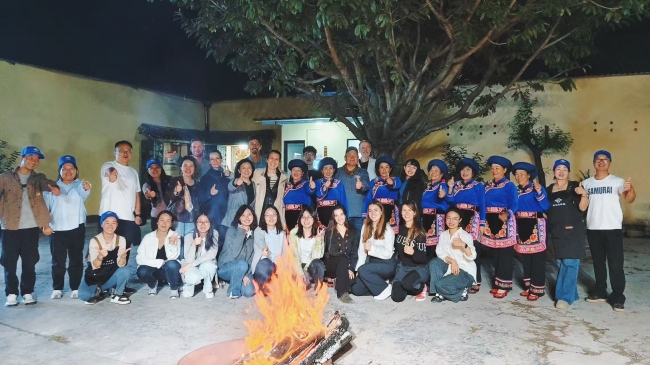 Closing Ceremony
While the field programme formally ended in Yunlong, the workshop activities continued in Shanghai. On 22 October, experts, scholars, and international student participants returned to prepare for an exhibition and a roundtable discussion. From 25 to 27 October, the UHC-HEI International Conference “Reshaping Heritage Conservation Education: Why? How? For Whom?” was organized by Tongji University and hosted by the College of Architecture and Urban Planning, the WHITR-AP Shanghai Office, and the academic journals Architectural Heritage and Built Heritage. The conference provided a platform for international dialogue on emerging approaches and trends in heritage conservation education.On the evening of 26 October, as a key component of the conference, the Yunlong workshop organized a roundtable discussion titled “Heritage After Hours: The Tangible/Intangible Debate,” which brought together participants, experts, scholars, and young heritage professionals to participate.
 Heritage After Hours: The Tangible/Intangible Debate
Simultaneously, an exhibition titled “International Workshop on the Conservation of Tangible and Intangible Cultural Heritage in Yunlong, Dali, China 2025” was presented in the Bell Court of Building B at the College of Architecture and Urban Planning, Tongji University.
 Experts and students at the exhibition
To conclude, the workshop successfully achieved its objective of engaging young heritage professionals and raising their voices, showcasing Yunlong’s rich tangible and intangible cultural heritage, as well as Tongji University’s contributions to rural revitalization. International experts highly praised Yunlong’s tangible and intangible cultural heritage, acknowledging that China’s traditional vernacular wisdom of harmonious human-nature coexistence holds positive significance for advancing global cultural heritage conservation Building on this shared understanding, the workshop produced research reports, a heritage database, and conservation strategies for Yunlong, which will inform future heritage conservation and rural revitalization initiatives. Furthermore, the “cultural ecosystem” research perspective and associated conservation toolkit developed through the Yunlong case are expected to be formalized into an ICOMOS document, contributing to continued international exchange and cooperation in heritage conservation.
Contributed by Zhang Tian & Annisa Rahma Amadea
Designed by Han Qier
Edited by Liu Zhen
Reviewed by Shao Yong |


- Review | A Broader View on Cultural Heritage: How to Include Both Intangible and Tangible Heritage When Documenting a Site
- Call for Application | 2026 Global Challenge for World Heritage Education Innovative Cases (AWHEIC)
- News | WHITR-AP Participated in the Brainstorming on World Heritage Higher Education in Africa
- Call for Papers | Reshaping Higher Education for Urban-Rural Heritage Conservation: Experiences, Concepts and Trends
- Lecture Recap | Prof. Nathan SCHLANGER: Excavating the City – Historical and Legal Developments of Preventive Archaeology in Urban Contexts
- New Year Message | UNESCO World Heritage Centre for Training and Research in the Asia and Pacific Region (Shanghai) Extends to You Its Sincere New Year Wishes!



Copyright © 2009-2026 World Heritage Institute of Training and Research for the Asia and the Pacific Region