
| Review | The Heritage Educational Landscape Exhibition |
| PublishDate:2025-12-31 Hits:6453 |
The Heritage Educational Landscape: Higher Education on Urban and Rural Heritage Conservation for Sustainable Development, was opened on Saturday 25 October 2025. Held in Tongji University at the College of Architecture and Urban Planning, Shanghai China, the exhibition was organized by World Heritage Institute of Training and Research for the Asia and the Pacific Region under the auspices of UNESCO, Shanghai Centre (WHITR-AP Shanghai), the College of Architecture and Urban Planning at Tongji University, with contributions from the Urban-rural Heritage Conservation in Higher Education Network (UHC-HEI). It complemented the Network’s first international conference on “Reshaping Heritage Conservation In Higher Education: What, How, For Whom?” – hosted by Tongji University and co-organised by WHITR-AP Shanghai and the College of Architecture and Urban Planning (CAUP), Tongji University on 25-26 October 2025.
Professor Shao Yong inaugurates the exhibition
Copyright ©WHITR-AP Shanghai
The inauguration was attended by a 100 participants of the Conference including more than 30 members of the UHC-HEI Network. It triggered on site exchanges and sharing of approaches between educational actors, comparing institutional settings, programs and research or field projects. The feedback was very positive, with very appreciative visitors coming back again and again.
Inauguration of the exhibition
Copyright © WHITR-AP Shanghai
Background
Inspired by UNESCO’s commitment to integrate culture and education more closely, with a focus on primary higher education and lifelong learning, the exhibition draws an international heritage educational landscape—picturing “what” is taught, “by whom”, “for whom”, and “how”, where and when to share global experiences, concepts, and trends in urban and rural heritage conservation in higher education.
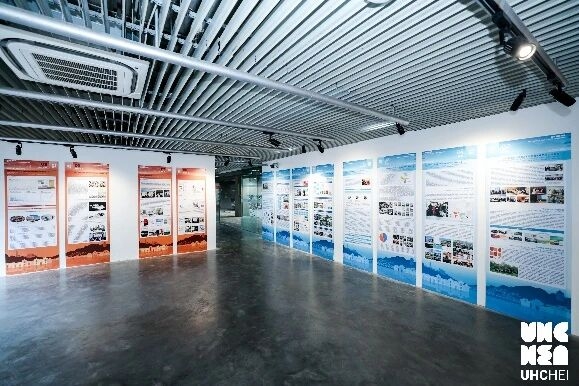
General View of the exhibition
Copyright ©WHITR-AP Shanghai
Capacity building in heritage conservation and culture-driven sustainability has become a global priority. This interdisciplinary challenge concerns not only educational institutions but also professional practitioners, national and local governments, international organisations — including the UNESCO World Heritage Committee — and UN-Habitat global policy platforms such as the World Urban Forum. It is also central to several international normative instruments, including the Convention Concerning the Protection of the World Cultural and Natural Heritage (1972), the Recommendation on the Historic Urban Landscape (2011), the New Urban Agenda (2016), the MONDIACULT Declaration on Cultural Policies and Sustainable Development (2022 and 2025), and the UNESCO Framework on Culture and Arts Education (2024) or international initiatives such as the ICOMOS University Forum or the endeavours of the ICOMOS Scientific Committee on Education and Training (CIF).
The Exhibition
The exhibition helped to clarify the existing global landscape of urban–rural heritage education and training programmes, and assist in identifying the key educators, learners, beneficiaries, and partners essential to enhancing educational quality.
The exhibition was divided in four parts:
1. A general introduction to the exhibition and a presentation of the organizing institutions: WHITR-AP and CAUP Tongji.
2. A presentation of the UHC-HEI Network itself, including a map and an introduction to the International partners UNESCO, UNESCO Chairs, ICOMOS, ICCROM and IUCN.
The Heritage Education Landscape: map of UHC-HEI Network partner institutions
Copyright © WHITR-AP Shanghai
3. Key references on Education, Research and Capacity Building in the World Heritage Convention and in the Recommendation on the Historic Urban Landscape
4. The 35 contributions provided by higher education institutions and international institutions of the UHC-HEI network.
Covering continents, including 10 UNESCO Chairs, displayed in two panels, the contributions by partners gave a concise overview of organizational structures, teaching areas and objectives, student profile, and target audiences as well as providing material on curriculum, reflections on pedagogy, field work and workshops, research or cooperation projects.
A comprehensive view of the exhibition hall
Copyright © WHITR-AP Shanghai
They demonstrated endeavours to address strengthening competencies within and outside the classroom, assessing the relevant skills required in the area of urban and rural heritage conservation and sustainable development as well as analysing the current educational practices in light of higher education institutions’ evolving strategies and aspirations of younger generations.
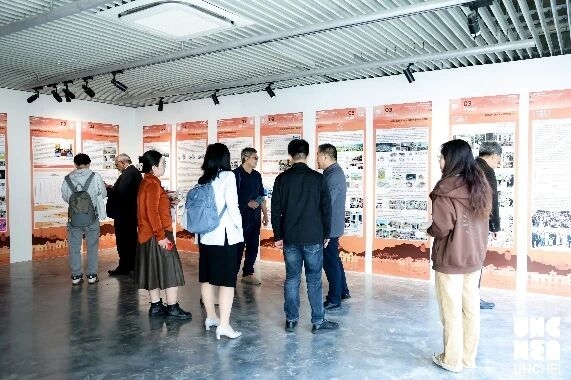
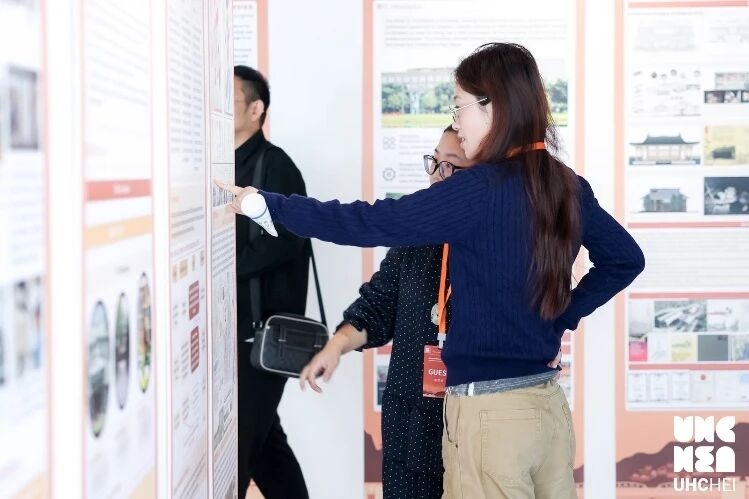
Visitors sharing views
Copyright © WHITR-AP Shanghai
The collective message by contributors to the exhibition advocated strengthened international cooperation among universities and relevant institutions in heritage education, the promotion of research and practice in urban–rural heritage conservation, and inclusive, multi-stakeholder approaches to address gaps in knowledge and capacity in the area of new technologies as well as traditional skills. They clearly demonstrated the need to address the future of educational practices to match the evolving skills required in the field of heritage conservation and beyond.
Visitors discussing at the exhibition Copyright © WHITR-AP Shanghai
Way Forward
Based on the eager interest by visitors and relevance for the UHC-HEI members to promote the exhibition, the Network will circulate the exhibition in other venues, make it accessible to all by developing an online format and continue collecting cases. The objective is to enhance the global influence of the exhibition and further promote the exchange of ideas and methods in global heritage education.
This exhibition on the "Heritage Educational Landscape" is the first step of the UHC-HEI Network’s ambition to develop a worldwide study on urban and rural heritage education. Building upon this exhibition, further investigation and research will be conducted into educational practices in the field of global urban and rural heritage conservation. It will serve as a base to further a study on educational practices and provide recommendations to contribute to the global discussion encouraged by UNESCO on Higher Education for Urban and Rural Heritage Conservation for Sustainable Development.
The overall objective of the exhibition and study to come is to benefit students — the next generation of professionals, researchers, educators and decision-makers.
We extend our sincere thanks to all institutions and organisations that have contributed to the exhibition!
Host
Tongji University
Organizers
World Heritage Institute of Training and Research for the Asia and the Pacific Region (Shanghai) under the auspices of UNESCO
College of Architecture and Urban Planning, Tongji University
Built Heritage Journal
Heritage Architecture Journal
Supporters
Chinese National Committee for the International Council on Monuments and Sites (ICOMOS China)
Shanghai Tongji Urban Planning and Design Institute Co.Ltd (TJUPDI)
Partners
ICOMOS: ICOMOS International Scientific Committees on Vernacular Architecture (CIAV), Education and Training (CIF) and International Committee on Intangible Cultural Heritage (ICICH) and ICOMOS Sustainable Development Goals Working Group (SDGWG), IFLA.
International Federation of Landscape Architects (IFLA)
UNESCO Chair on Restoration and Conservation Heritage Structures
UNESCO Chair on Living Heritage and Community Development
UNESCO Chair on Heritage and Urban Regeneration
UNESCO Chair on Water, Ports and Historic Cities
UNESCO Chair on Modern Urban Heritage CREhAR (Creative Research and Education on Heritage Assessment and Regeneration)
UNESCO Chair in Urban Design and Conservation Studies
UNESCO Chair on Historic Urban Landscapes and Cultural Heritage Impact Assessment
UNESCO Chair on Historic Urban Landscape
UNESCO Chair and UniTwin Network in Earthen Architecture
UNESCO UniTwin Network on African Heritage and Archives
Conservation Planning of Famous Historical and Cultural City Division, Urban Planning Society of China
Urban Regeneration Division, Urban Planning Society of China
Chinese Society of Landscape Architecture
Study on Natural and Cultural Heritage Journal
Urban Planning Forum Journal
Frontiers of Urban and Rural Planning Journal
University of Lagos, Department of Architecture & Urbanism Research Hub
International University of Rabat, School of Architecture
University of Melbourne, Australian Centre of Architectural History, Urban and Cultural Heritage (ACAHUCH)
University of Dhaka, Department of Anthropology
Tsinghua University, National Heritage Centre
Southwest Jiaotong University, School of Architecture
Southeast University, School of Architecture
Fudan University
Harbin Institute of Technology, Future Design School
Tianjin University, School of Architecture
Xiamen University, School of Architecture and Civil Engineering (XMU-SACE)
University of Hong Kong, Faculty of Architecture
Macau University of Science and Technology, Faculty of Humanities and Arts
Guru Nanak Dev University, Guru Ram Das School of Planning
Kamla Raheja Vidyanidhi Institute for Architecture and Environmental Studies (KRVIA)
National University of Singapore, Architectural Conservation Program (NUS MAArC)
Cité de l’Architecture et du Patrimoine, The École de Chaillot
School of Architecture, Paris-Belleville (MAGE Chair, DSA Architecture and Heritage)
CRATerre International Centre on Earthen Research / School of Architecture of Grenoble
National Research Council of Italy, Institute of Heritage Science (CNR-ISPC)
Delft University of Technology (TU Delft)
University of Catalonia, Barcelona School of Architecture (UPC ETSAB)
University of Seville, School of Architecture
Valencia Polytechnic University, School of Architecture
University College London, Bartlett School of Architecture
University of Westminster, School of Architecture and Cities
University of Pennsylvania, Weitzman School of Design
Abdullah Gül University, Faculty of Architecture
Bezalel Academy of Arts and Design
Pontifical Catholic University of Valparaiso
International Federation of Landscape Architects (IFLA), Education & Academic Affairs Committee
Curators
Shao Yong, Secretary-General, WHITR-AP; Director, WHITR-AP Shanghai; Professor, College of Architecture and Urban Planning, Tongji University
Zhang Peng, Deputy Dean and Professor, College of Architecture and Urban Planning, Tongji University
Marie-Noël Tournoux, Project Director, WHITR-AP Shanghai
Project Execution
Liu Zhen, Programme Specialist, WHITR-AP Shanghai
Design
Shi Si, Graphic Designer
Contributed by Marie-Noël Tournoux & Tang Zhuping (Intern)
Designed by Tang Zhuping (Intern)
Edited by Liu Zhen
Reviewed by Shao Yong |


- News | Secretary-General of the WHITR-AP and Delegation from the Suzhou Sub-Centre Visit the UNESCO World Heritage Centre
- News | 2026 HeritAP Chat on World Heritage Contribution to SDGs Knowledge & Skills
- News|Executive Vice President Lyu Peiming Meets with UNESCO External Evaluation Expert
- News | UNESCO Office in Hanoi and WHITR-AP Shanghai Hold Bilateral Cooperation
- Preview丨2026 HeritAP Chat on WH Contribution to SDGs Knowledge & Skills
- 2026 Call for Applications | Young Masters for Heritage Conservation




Copyright © 2009-2026 World Heritage Institute of Training and Research for the Asia and the Pacific Region