
| News | WHITRAP participated in WHIPIC Roundtable Dialogue: The Role and Vision of Capacity Building in World Heritage Interpretation |
| PublishDate:2023-09-06 Hits:3224 |
On June 28, Ms. SHAO Yong, Executive Director of WHITRAP Shanghai, participated in the WHIPIC Roundtable Dialogue: The Role and Vision of Capacity Building in World Heritage Interpretation. The International Centre for the Interpretation and Presentation of World Heritage Sites under the auspices of UNESCO (WHIPIC) organized the roundtable dialogue.
2023 UNESCOWHIPIC Roundtable Dialogue, event cover The future of interpretation and presentation of World Heritage, and the future of capacity building are crucial topics in the present day. Interpretation connects heritage and people, and capacity building is a catalyst for achieving inclusive heritage interpretation.
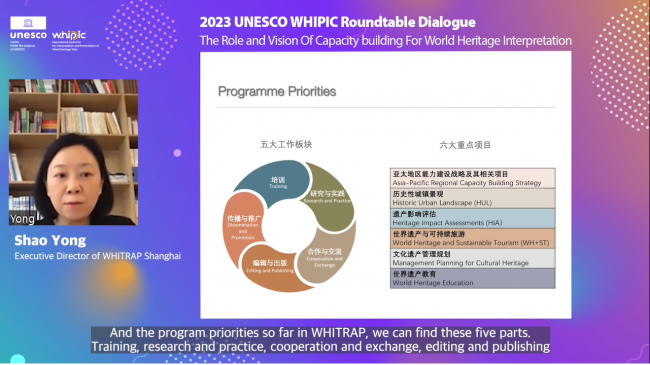
Ms. SHAO Yong presenting Ms. Haeree SHIM and Ms. Valya STERGIOTI respectively introduced the goals of capacity building programs in their organization. WHIPIC aims to contribute to accelerating sustainable development through the conservation and promotion of a World Heritage Site achieved by three specific main goals. Interpret Europe tries to develop the competencies and skills required to develop and implement value-based interpretation. |


- News|Executive Vice President Lyu Peiming Meets with UNESCO External Evaluation Expert
- News | UNESCO Office in Hanoi and WHITR-AP Shanghai Hold Bilateral Cooperation
- Preview丨2026 HeritAP Chat on WH Contribution to SDGs Knowledge & Skills
- 2026 Call for Applications | Young Masters for Heritage Conservation
- News| Growing Up in Pingyao Named to the 100 Best Books of the 13th “New Reading China Children‘s Book List” (2025)
- News | First Session of UHC-HEI Steering Committee



Copyright © 2009-2026 World Heritage Institute of Training and Research for the Asia and the Pacific Region