
| Call for Papers | Reshaping Higher Education for Urban-Rural Heritage Conservation: Experiences, Concepts and Trends |
| PublishDate:2026-03-16 Hits:5193 |
GUEST EDITOR
Prof. Yong Shao College of Architecture and Urban Planning, Tongji University
DEADLINES
Submission deadline for extended abstracts 30 April 2026
Submission deadline for full papers 31 Oct 2026
AIMS AND SCOPE
The Sustainable Development Goals (SDGs) adopted by the United Nations and the Recommendation on the Historic Urban Landscape (HUL) issued by UNESCO jointly underscore the central importance of culture and heritage as catalysts for more sustainable, higher-quality development. Achieving sustainable development through heritage, particularly across the urban-rural continuum, requires new knowledge, novel methods, and updated skills, as well as closer interdisciplinary collaboration toward shared goals. It also calls for experimentation with research and pedagogical models that reconcile traditional knowledge systems with emerging tools such as artificial intelligence. As principal actors in this process, universities and higher education institutions have an enduring responsibility to educate professionals equipped for contemporary challenges and to pursue frontier research and teaching that can fundamentally reshape the human environment.
This special issue focuses on frontier theory and innovative practice in higher education institutions for urban–rural heritage conservation, and on approaches for integrating heritage conservation with sustainable development. We welcome papers that probe the fundamental aims of heritage education, introduce methodological and pedagogical innovations, and examine mechanisms for professional formation. Contributions that analyse new challenges and opportunities under conditions of globalisation, and that help advance forward-looking, strategically oriented disciplinary consensus, are particularly encouraged.
We invite both theoretical and empirical contributions on higher education in urban–rural heritage conservation. Topics include, but are not limited to, the following:
1. Histories of heritage education. Research tracing the historical evolution of heritage education, including analyses of former curricula and teaching methods, studies of the transmission of traditional construction systems and craft knowledge, and critical reflections on the present state and future directions of the field.
2. Pedagogical and theoretical innovation. Studies that address the gap between existing theoretical frameworks and the diversity of contemporary practice: how to strengthen the dialogue between values-based perspectives and technical methods; how education can better respond to challenges such as climate change, rapid urbanisation, and social equity; and how local and traditional knowledge can be effectively mainstreamed into higher education. Interdisciplinary and place-based educational models and novel curricular frameworks are particularly encouraged.
3. Integration of new technologies in heritage education. Investigations of digital and computational tools in teaching, such as artificial intelligence, Heritage Building Information Modelling (HBIM), and immersive technologies (VR/AR), that assess both their pedagogical potential and the tensions they may create between technocratic approaches and the humanistic foundations of conservation.
PROPOSED TIMELINE
30 Apr 2026 Abstracts (500-800 words) 31 May 2026 Acceptance decision and invitation
31 Oct 2026 First draft submission and start of peer review 31 May 2027 Final version
30 June 2027 Publication (paper version) 
All submissions to this collection will go through rigorous peer review. Reviewers will follow Springer Nature's and the journal's more detailed Peer-Review Policy. Accepted articles will be first be published online. The print issue is scheduled to be published in the second quarter of 2027.
Abstracts (500-800 words) should contain the title of the paper, research question, methodology, main findings, and conclusions. Abstracts should be submitted to: built-heritage@tongji.edu.cn with the subject line:
Reshaping Higher Education for Urban-Rural Heritage Conservation.
Questions may be addressed by email to: built-heritage@tongji.edu.cn
Prof. Yong Shao: nyshao163@163.com

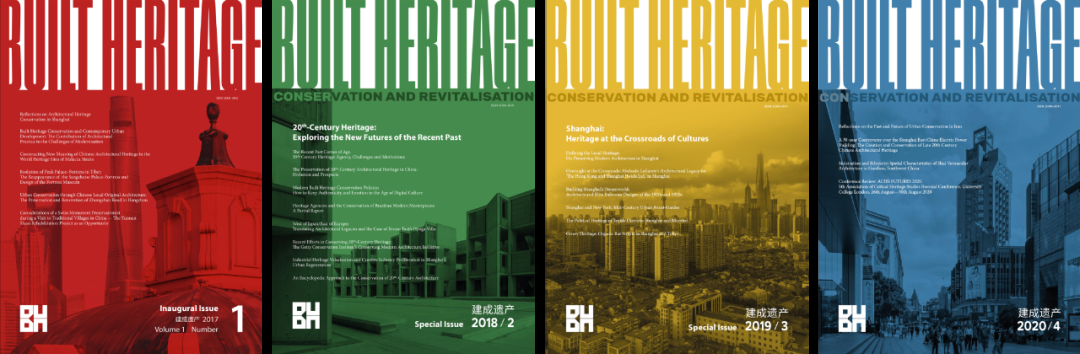
Built Heritage
CSCD | DOAJ | Scopus |WJCI(STM) CiteScore 2.4 SJR 0.418 SNIP 1.144 Official Website|www.built-heritage.net
Email Adress|built-heritage@tongji.edu.cn
Telephone|+ 86 21 65982193
|


- News | 2026 HeritAP Chat on World Heritage Contribution to SDGs Knowledge & Skills
- News|Executive Vice President Lyu Peiming Meets with UNESCO External Evaluation Expert
- News | UNESCO Office in Hanoi and WHITR-AP Shanghai Hold Bilateral Cooperation
- Preview丨2026 HeritAP Chat on WH Contribution to SDGs Knowledge & Skills
- 2026 Call for Applications | Young Masters for Heritage Conservation
- News| Growing Up in Pingyao Named to the 100 Best Books of the 13th “New Reading China Children‘s Book List” (2025)




Copyright © 2009-2026 World Heritage Institute of Training and Research for the Asia and the Pacific Region