
| Review | A Broader View on Cultural Heritage: How to Include Both Intangible and Tangible Heritage When Documenting a Site |
| PublishDate:2026-03-30 Hits:5449 |
At 8:00pm Beijing Time on March 15, 2026, the online café themed "A Broader View on Cultural Heritage: How to Include Both Intangible and Tangible Heritage When Documenting a Site" was successfully organized by the ICOMOS International Committee on Vernacular Architecture (ICOMOS-CIAV). The event was convened and chaired by Ms. Marwa Dabaieh, Vice President of ICOMOS-CIAV, with a keynote speech delivered by Mr. Gisle Jakhelln, former President of ICOMOS-CIAV. Following the presentation, experts from international heritage organizations, including ICOMOS-CIAV and the ICOMOS International Committee on Intangible Cultural Heritage (ICOMOS-ICICH), engaged in an in-depth discussion.
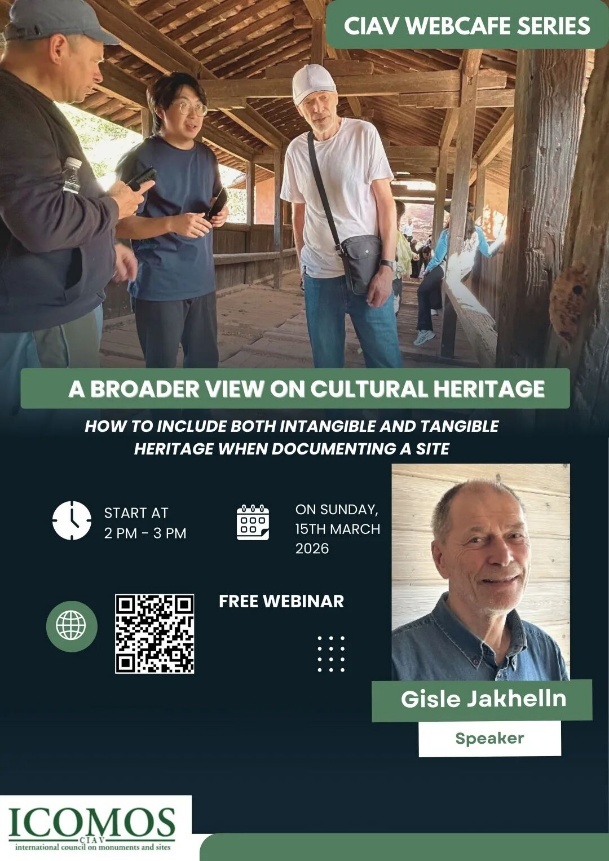 Poster of Online Café
This online café focused on the achievements of the VIDA Group—the Vernacular Tangible and Intangible Cultural Heritage Group. Established in October 2022, the group was co-initiated by experts from ICOMOS-CIAV and ICOMOS-ICICH. Its core mission and overall objective are to contribute to the preservation of vernacular architectural heritage for future generations by pioneering a balanced conservation approach that integrates the intangible cultural heritage dimension. Specifically, the working group is dedicated to developing a toolkit/manual for the synchronized documentation of both tangible and intangible cultural elements during the research and protection of vernacular sites. In the field of World Heritage, the long-term goal is to apply this toolkit to the documentation of Outstanding Universal Value (OUV) and Heritage Impact Assessments (HIA).
The online café began with an introduction to the VIDA Group by Gisle Jakhelln. He shared the group’s founding process and elaborated on the experiences gained from the inaugural VIDA Workshop held in Yunlong County, Dali Bai Autonomous Prefecture, Yunnan Province, China, in October 2025. This workshop was jointly organized by Tongji University, the World Heritage Institute of Training and Research for the Asia and the Pacific Region under the auspices of UNESCO (WHITR-AP), ICOMOS-CIAV, and ICOMOS-ICICH, and hosted by WHITR-AP Shanghai, the College of Architecture and Urban Planning (CAUP) at Tongji University, and the People's Government of Yunlong County.
As the first international workshop of the VIDA Group , it took Yunlong’s thousand-year-old salt production industry as a case study. It revealed and documented an extraordinary salt culture ecosystem rich in both tangible and intangible heritage, providing a model for synergistic conservation paths. As the inaugural event of the future VIDA workshop series, it offered experience for organizing international heritage workshops.
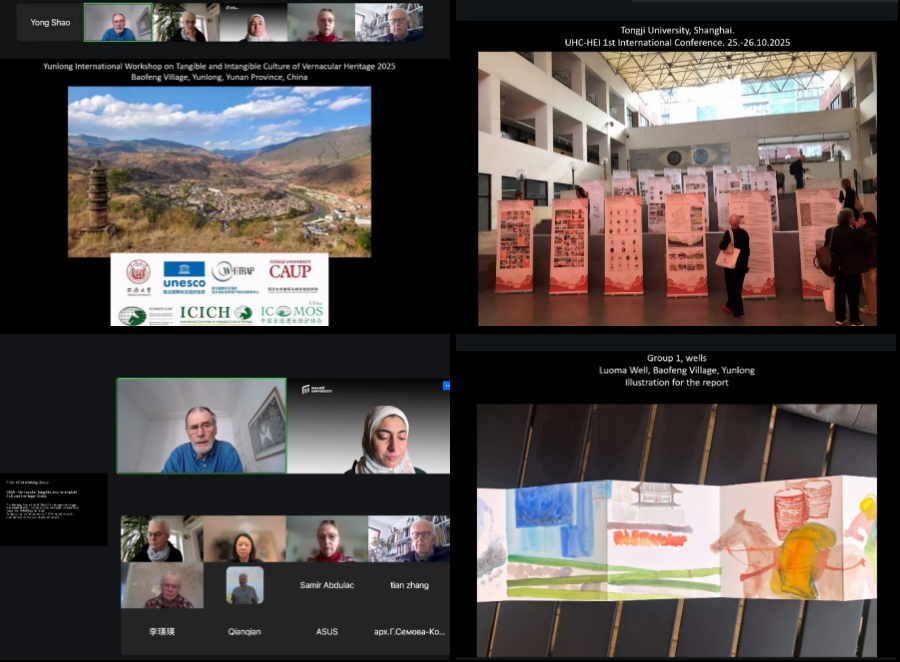 Keynote Speech by Gisle Jakhelln
Participating experts affirmed the outcomes of the workshop and reached a consensus on continuing the VIDA workshop series. Experts including Lena Palmqvist, Maria Ines Subercaseaux, Amund Sinding-Larsen, Hossam Mahdy, and Shao Yong discussed potential schedules, locations, and formats for future workshops, analyzing the possibility of hosting events in South Asia, the Middle East, and Africa. The experts agreed that tangible and intangible heritage conservation are of equal importance; therefore, the selection of future sites must assess the richness of both heritage types to foster a profound understanding of local cultures. Furthermore, the participants discussed alternative contingency plans for organizing workshops amidst increasing global political and economic uncertainties to ensure the safety and smooth implementation of future activities.
Contributed by ZHANG Tian Designed by HAN Qier Web typeset by Zhang Yidan (Intern) Edited by LIU Zhen Reviewed by SHAO Yong |


- News | Secretary-General of the WHITR-AP and Delegation from the Suzhou Sub-Centre Visit the UNESCO World Heritage Centre
- News | 2026 HeritAP Chat on World Heritage Contribution to SDGs Knowledge & Skills
- News|Executive Vice President Lyu Peiming Meets with UNESCO External Evaluation Expert
- News | UNESCO Office in Hanoi and WHITR-AP Shanghai Hold Bilateral Cooperation
- Preview丨2026 HeritAP Chat on WH Contribution to SDGs Knowledge & Skills
- 2026 Call for Applications | Young Masters for Heritage Conservation



Copyright © 2009-2026 World Heritage Institute of Training and Research for the Asia and the Pacific Region