
| News | 2026 HeritAP Chat on World Heritage Contribution to SDGs Knowledge & Skills |
| PublishDate:2026-06-02 Hits:77 |
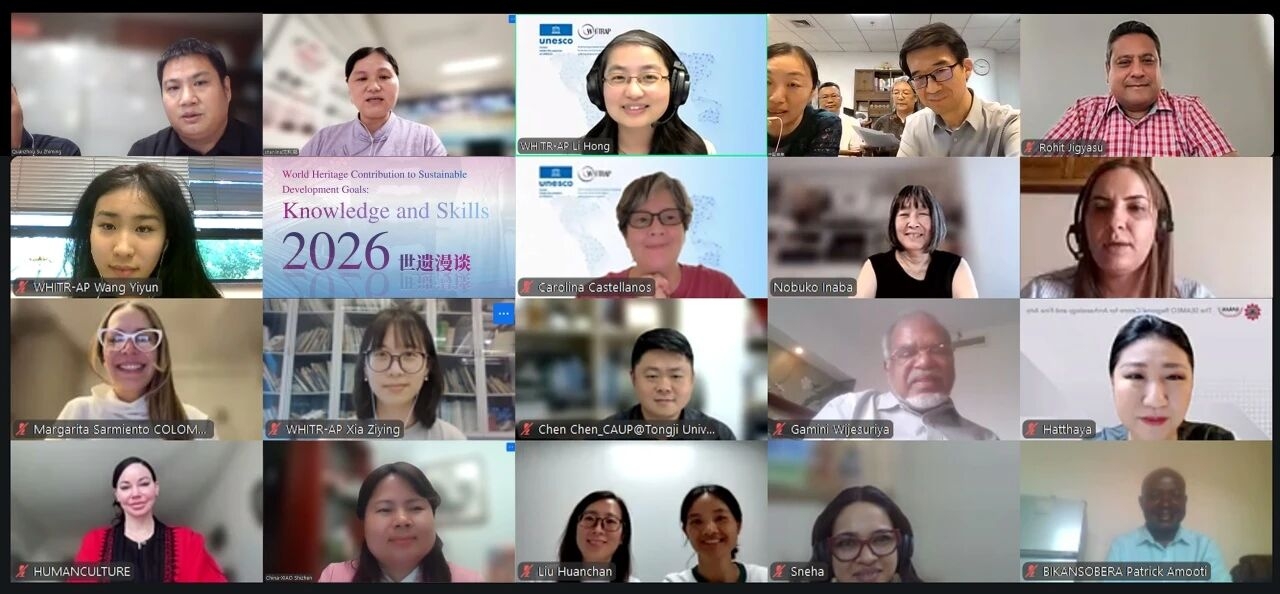 Group photo of participants
On May 28, 2026, the 2026 HeritAP Chat on WH Contribution to SDGs Knowledge & Skills was successfully held. The event was organized by the World Heritage Institute of Training and Research for the Asia-Pacific Region under the auspices of UNESCO (WHITR-AP Shanghai). Six experts from India, China, Mexico, Thailand, Japan, and Sri Lanka participated and representatives from 11 heritage sites across six countries (Syria, China, Tanzania, Uganda, India, and Colombia) presented their cases and engaged in discussions with the expert panel to provide supplementary information. The livestream attracted a total of 3,104 viewers.
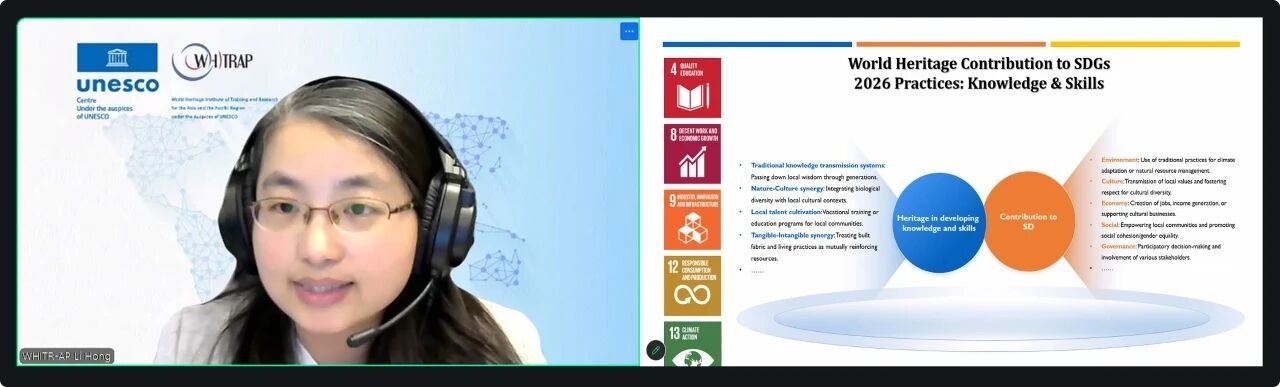
LI Hong, Project Director of WHITR-AP Shanghai, introduced the World Heritage Contribution to Sustainable Development Goals (2023–2028) initiative and the focus of the 2026 Call for Practices. Through capacity development, professional exchange, and policy guidance, this year’s edition of the project focuses on the thematic dimension of knowledge and skills, examining how traditional knowledge, community values, policy and institutional commitment can leverage heritage to promote cultural diversity, empowerment and the overall contribution to sustainable development. A total of 87 project applications from 25 countries were received, including 40 World Heritage properties, 15 sites on the Tentative List, and 9 other heritage categories. Twelve cases were shortlisted in the first round of evaluation. Following their presentation and discussing supplementary aspects, selected projects will be invited to participate in the Annual Meeting of the HeritAP network, where the 2026 Good Practices on World Heritage contributions to the SDGs in Knowledge and Skills will be further announced.
 Expert: Rohit Jigyasu, Project Manager, ICCROM Project representative: Shereen Naddaf, Tangible Heritage Program Manager, Syrian Development Organization
The project "A model for reviving living water heritage after disasters with local development and participatory governance" is led by the Syrian Development Organization and focuses on the historic waterwheels of Hama, a unique form of living water heritage in Syria. The project adopts a comprehensive approach that combines physical conservation, transmission of traditional craftsmanship, and participatory governance. Three key waterwheels have undergone structural reinforcement and functional restoration, enabling them to return to operation. Practical conservation training related to site maintenance has been provided to young craftspeople, while more than fifty university students have also participated in capacity-building activities. The project demonstrates how cultural heritage conservation can be integrated with livelihood recovery and community development in post-crisis contexts, offering a replicable model for heritage sites facing natural disaster risks or the loss of traditional skills.
 Expert: LI Hong, Project Director, WHITR-AP Shanghai Project representative: LIU Huanchan, Deputy Director, Kaiping Municipal Bureau of Culture, Radio, Television, Tourism and Sports, Guangdong, China
The project "Inheritance and Development of the Overseas Chinese Culture in Kaiping Diaolou and Villages - A Case Study of the Cangdong Village Project and the Revitalization of Tangkou Town" takes the Kaiping Diaolou and Villages World Heritage property as the driving force to explore pathways for reconnecting heritage knowledge and traditional skills with local communities. The Cangdong Initiative has focused on rural settlements, fostering cultural awareness and strengthening local identity among residents while transforming heritage sites into living spaces for cultural learning and transmission. Meanwhile, the Tangkou cultural and tourism district has revitalized underutilized historic buildings and public assets, converting abandoned granaries into public cultural venues. The project has also established a comprehensive digital knowledge system and completed systematic documentation of the Kaiping Diaolou, creating an open and shared repository of heritage resources.
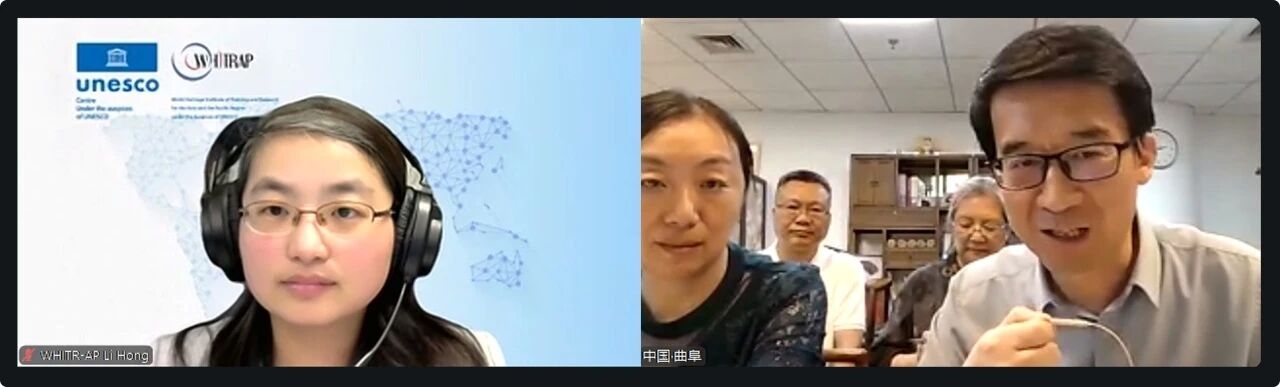 Project representative: ZHOU Kai, Vice Mayor of Qufu City, Shandong Province, China
The project "Integration of Knowledge and Action: Confucian Cultural Heritage and Digital-Intelligent Education Innovation at the Three Confucian World Heritage Sites in Qufu" is based on the Temple and Cemetery of Confucius and the Kong Family Mansion World Heritage property in Qufu. Centered on traditional knowledge systems embodied in Confucian values, the project has established a knowledge-transmission ecosystem that integrates tangible heritage with intangible cultural heritage elements, including the Confucius Commemoration Ceremony, wood carving, and the abacus culture. The project has developed a tiered curriculum framework and incorporated digital tools such as SLAM positioning, AR interaction, and AI-assisted learning. Intangible cultural heritage skills have been transformed into teachable vocational training modules. Furthermore, it has collaborated with local schools and heritage bearers to conduct integrated “ICH + Digital Technology” training. By cultivating young people's capacities in both cultural interpretation and heritage communication, the project has made significant contributions to promoting cultural diversity and educational equity.
 Project representative: SHEN Lina, Associate Research Fellow Institute of Karst Geology, Chinese Academy of Geological Sciences
The project "Living Transmission of the Luo Family Wood-Firing Ceramic Technique and Community Co-development in the Wulong Karst World Natural Heritage Site" builds upon the resource advantages of the South China Karst (Wulong Karst) World Heritage property . Drawing inspiration from local heritage resources, the project develops creative wood-fired ceramic products that incorporate distinctive elements. Through activities in schools and communities, as well as permanent experience activities established within scenic areas, the project promotes intangible cultural heritage awareness and heritage education. By integrating culture and tourism, the initiative has created employment and income opportunities for more than one hundred local residents, contributing to steady improvements in community livelihoods. The project explores a development pathway that combines World Heritage, a century-old intangible cultural heritage tradition, and community co-development, providing a valuable model for the transmission of traditional skills and sustainable community development in natural heritage sites.
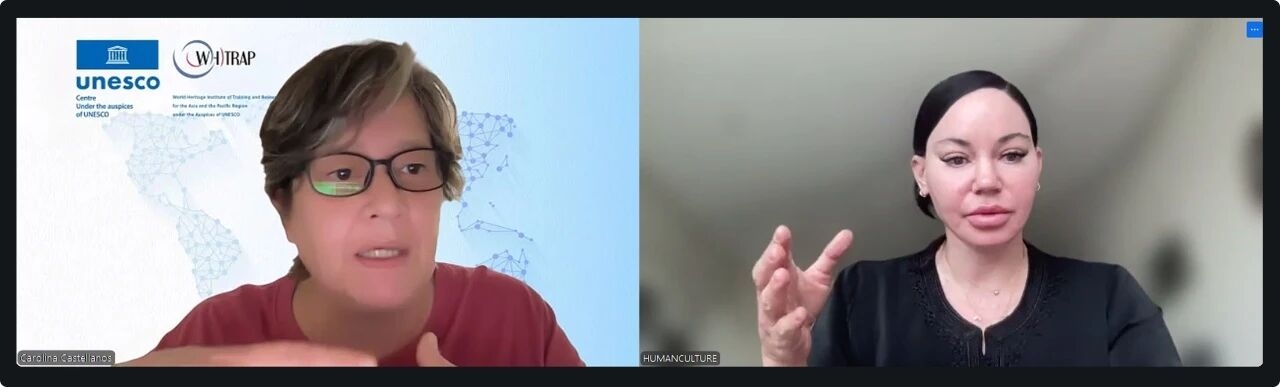 Expert: Carolina Castellanos, Head of Research, WHITR-AP Shanghai
Project representative: Stephanie Zabriskie, Founder, HUMANCULTURE
The project "Maasai Groundwater Knowledge and Skills Transmission in the Ngorongoro Conservation Area" focuses on the transmission of Maasai traditional knowledge and skills. The Maasai community possesses complex knowledge systems related to groundwater identification, manual well-digging, and collective water governance, that has been passed down through generations. When drought causes surface water shortage, community members are able to locate underground water, extract and store it by using traditional techniques to ensure the reliable access to water for tens of thousands of residents, livestock and wildlife. This knowledge system has enabled communities to endure multiple severe droughts successfully. The project demonstrates that ancestral environmental knowledge, practical skills, and community governance are not separate measures but components of an integrated system. Its holistic approach of “knowledge, skills, and governance” offers valuable lessons for heritage places confronting water scarcity and climate fluctuations.
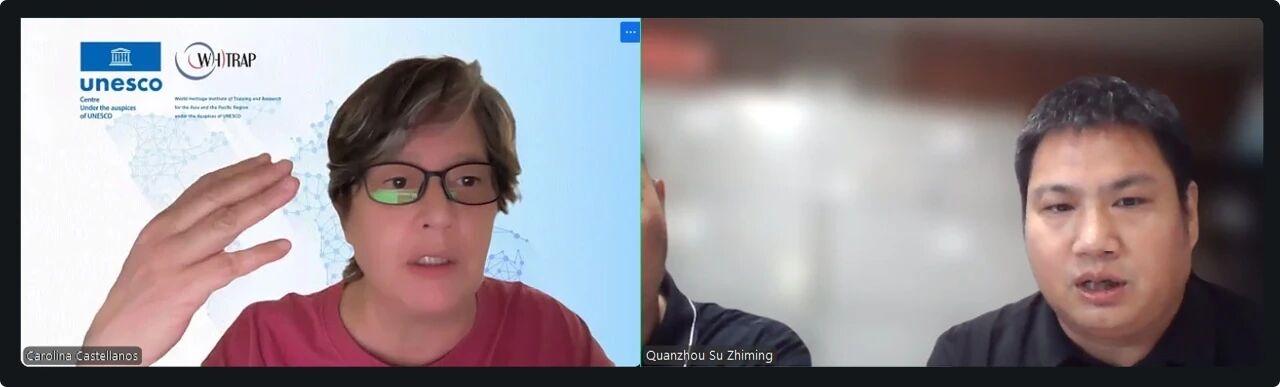 Project representative: SU Zhiming, Director of the World Heritage Department, Quanzhou Cultural Relics Protection Center, Fujian Province, China
Three heritage focused initiatives have been implanted at the World Heritage property of Quanzhou: Emporium of the World in Song-Yuan China. "The Maritime Silk Road Quanzhou · Digital-Intelligent World Heritage" uses digital tools such as AI-guided tours and knowledge graphs to integrate heritage content into K–12 education. It has reached over 30,000 students and developed specialized courses. The second, "Quanzhou, a World Heritage City: Empowering Heritage Conservation with Knowledge and Skills Training, Inheriting Minnan's Traditional Cultural Heritage" emphasizes grassroots capacity building, training over 12,000 individuals in conservation, establishing a traditional knowledge database, and employing public interest litigation for heritage protection. The third, Quanzhou "Traditional Architecture in New Vibe" Sustainable Livelihoods, focuses on heritage skill transmission, cross-cultural exchange, and youth heritage education. It provides platforms for practitioners through the compilation of maintenance manuals, database construction, technical training, and international academic seminars. By linking heritage sites with community life, residents participate in heritage practices, share development benefits, and strengthen cultural identity.
These projects combined illustrate how heritage can be integrated into everyday life, strengthening sense of cultural identity and belonging in communities and creating economic benefits and livelihoods. It also exemplifies the integration intangible cultural heritage and World Heritage as a pathway toward culturally driven sustainable development.
 Expert: Hatthaya Siriphatthanakun, Centre Director of SEAMEO SPAFA Project representative: Bikansobere Patrick Amooti, Project Officer, Banyabindi Cultural and Development Trust
The project "Community-Driven Preservation of Banyabindi Cultural Heritage through Knowledge Transfer and Skills Development" is centered on Rwenzori Mountains National Park in Uganda. Aiming to revitalize the indigenous knowledge systems of the Banyabindi people, who have been displaced from their original lands, the project regards traditional knowledge and living cultural practices as key drivers of sustainable development.
Through activities such as documenting indigenous knowledge and practices, the initiative strengthens intergenerational transmission while enhancing community cohesion and cultural identity among the Banyabindi people. It also promotes social inclusion and community empowerment, providing a mature model for cultural continuity, heritage education, and sustainable development in Indigenous communities located around World Heritage properties.
 Expert: Nobuko Inaba, Director of Mt. Fuji World Heritage Centre; Professor of University of Tsukuba Project representative: Chen Chen, Professor / Vice Dean, College of Architecture and Urban Planning, Tongji University
The project "Rural Community Co-Creation Practice in Zhouzhuang Ancient Town, China: A Doctoral Team Pilot Project for Safeguarding Heritage Knowledge and Fostering Collaborative Innovation" focuses on the historic water town of Zhouzhuang in the Jiangnan region. Led by young scholars and through university–local government collaboration, the project transforms heritage into a cultural ecosystem that continuously generates knowledge, cultivates skills, and promotes local development.
The program focuses on four parts: reframing heritage values, applying knowledge into practice, building skills ecosystems and unlocking development potential. It systematically identifies both tangible and intangible heritage and establishes a coherent and transferable local knowledge system. Through university-based talent development and community participation, the project strengthens living heritage conservation, intergenerational cultural transmission, community vitality, and the transformation and upgrading of local cultural tourism industries, offering a replicable model for the safeguarding of water-towns.
 Project representative: XIAO Shizhen, Professor, School of Karst Science, Guizhou Normal University
The project "The Artistry at the Tip of the Needles: The Local Communities Enhance the Conservation and Restoration of the Guizhou Triassic Fossil Sites" has been implemented at the Guizhou Triassic fossil sites. It aims to strengthen systematic conservation, promote scientific research, enhance local residents’ awareness of heritage protection, and develop professional skills related to fossil conservation while establishing an effective heritage management mechanism to support sustainable local development.
Led by government agencies, the project has implemented fossil research, restoration training, and public education programs, cultivating more than eighty farmer fossil restorers. Local villagers have been transformed into skilled craftspeople, research assistants, and site guardians. By reducing illegal fossil excavation at its source and creating employment opportunities in fossil restoration, the project has supported heritage tourism and rural revitalization while achieving a balance between heritage conservation, community empowerment, and local development.
 Expert: Gamini Wijesuriya, Special Advisor, WHITR-AP Shanghai Project representative: Sneha Bhattacharyya, Secretary, Contact Base
The project "Project SETU (Skills, Education and Tangible–Intangible Heritage Unity) in the Santiniketan Cultural Landscape" is based on the Santiniketan Cultural Landscape and is inspired by the vision of Rabindranath Tagore. Focusing on skills development, educational empowerment, and the integration of tangible and intangible heritage, the initiative encompasses a wide range of traditional cultural practices, including music, embroidery, pottery, metal casting, and folk performance traditions.
Through artisan-led instruction, skills training, festivals, exhibitions, and collaboration with educational institutions, the project strengthens intergenerational transmission, expands livelihood and market opportunities for craftspeople, enhances cultural identity and social inclusion, and has developed a mature model of community-led heritage-based development supported by multi-stakeholder collaboration.
 Project representative: Margarita Maria Sarmiento Lopez, Founder, DVOTIO SAS
The project DVOTlO4SDGs: "We celebrate the devotion of our ancestors by crafting their memory into sustainable futures" has been implemented at the World Heritage property of Qhapaq Ñan, Andean Road System, specifically in the sections of Colombia and Ecuador. The initiative seeks to strengthen the social and economic viability of intangible heritage practices, mainly traditional textile knowledge and artisanal practices, that have evolved within this transnational cultural landscape over centuries.
Recognizing these practices as important drivers of sustainable development, the initiative combines intergenerational knowledge transmission with systematic economic empowerment. It has established a replicable model that promotes community co-creation, gender empowerment, ecological regeneration, and market engagement, demonstrating how living heritage can contribute to inclusive and sustainable development. The twelve cases presented demonstrate that the transmission and application of heritage-related knowledge and skills are powerful drivers for multiple Sustainable Development Goals.
By systematically documenting, revitalizing, and passing down indigenous and traditional knowledge, ranging from Maasai groundwater governance and Syrian waterwheel craftsmanship to Confucian digital-intelligent education and Luo family wood-firing ceramics, these projects directly contribute to Quality Education through intergenerational and vocational training, Decent Work and Economic Growth by creating heritage-based livelihoods and market opportunities, and Sustainable Cities and Communities by strengthening cultural identity and local governance. Several cases also advance Gender Empowerment and Climate Action, illustrating how heritage skills foster resilience against drought, post-crisis recovery, and ecological balance.
The cases show that knowledge and skills function not as isolated assets but as integrated systems for sustainable development. They combine physical conservation with participatory governance, digital documentation with community revitalization, and indigenous governance with climate adaptation. They also emphasize skill ecosystems, like the farmer fossil restorers in Guizhou, the artisan-led training in Santiniketan, and doctoral-led co-creation in Zhouzhuang, which bridge formal education, local practice, and economic empowerment.
By transforming heritage knowledge into teachable, scalable, and income-generating skills, these initiatives provide replicable models for achieving Partnerships for the Goals through multi-stakeholder collaboration, while ensuring that no community is left behind in the pursuit of sustainable, culturally inclusive development.
Contributed by Xia Ziying (Intern) Carolina Castellanos Designed by Xia Ziying (Intern) Web typeset by Zhang Yidan (Intern) Edited by Liu Zhen Reviewed by Shao Yong |
|
|


- News | 2026 HeritAP Chat on World Heritage Contribution to SDGs Knowledge & Skills
- News|Executive Vice President Lyu Peiming Meets with UNESCO External Evaluation Expert
- News | UNESCO Office in Hanoi and WHITR-AP Shanghai Hold Bilateral Cooperation
- Preview丨2026 HeritAP Chat on WH Contribution to SDGs Knowledge & Skills
- 2026 Call for Applications | Young Masters for Heritage Conservation
- News| Growing Up in Pingyao Named to the 100 Best Books of the 13th “New Reading China Children‘s Book List” (2025)


Copyright © 2009-2026 World Heritage Institute of Training and Research for the Asia and the Pacific Region