
| Publication | Official Chinese Version of UNESCO’s Guidance and Toolkit for Impact Assessments in a World Heritage Context Released |
| PublishDate:2025-07-19 Hits:430 |
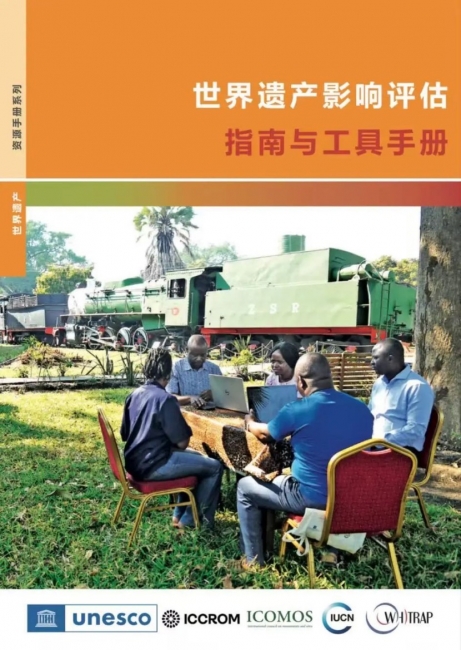 Official Chinese Version of UNESCO’s Guidance and Toolkit for Impact Assessments in a World Heritage Context (cover)
Click "
 世界遗产影响评估指南与工具手册" or download it from the UNESCO website 世界遗产影响评估指南与工具手册" or download it from the UNESCO website
Introduction
On 1st July 2025, WHITR-AP Shanghai released the official Chinese version of the Guidance and Toolkit for Impact Assessments in a World Heritage Context (hereinafter referred to as “the Guidance”). The 2022 edition of the Guidance builds upon three key foundations:
· the Guidance on Impact Assessment for Cultural World Heritage Properties issued by ICOMOS in 2011; · the World Heritage Advice Note on Environmental Assessment published by IUCN in 2013; · a series of training courses on heritage impact assessment, jointly organized by ICCROM and WHITR-AP Shanghai since 2012.
The Guidance is designed as both a methodological guide and a practical toolkit for States Parties to the Convention Concerning the Protection of the World Cultural and Natural Heritage (hereinafter “the World Heritage Convention”), heritage protection institutions, local governments, site managers, local communities, and other stakeholders involved in heritage conservation. By promoting cross-sectoral and interdisciplinary collaboration, it seeks to identify effective pathways that balance heritage protection with high-quality and appropriate development. Background
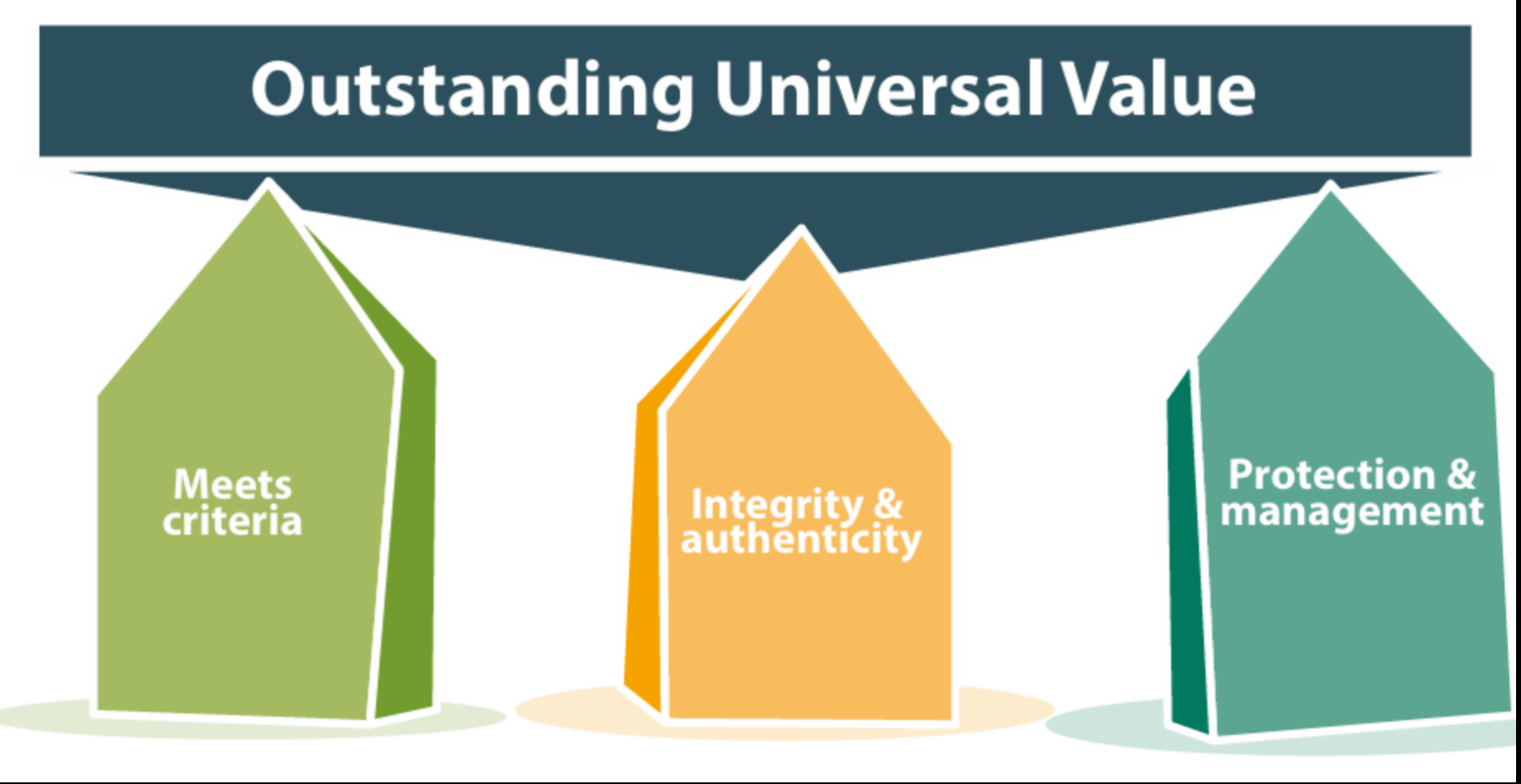
According to the State of Conservation Reports, World Heritage properties and their surrounding areas are increasingly facing development pressures, such as tourism expansion, infrastructure construction, new buildings, urban renewal, and land-use changes. These activities may affect the Outstanding Universal Value (OUV) of heritage sites. While such developments may bring social benefits, the World Heritage Committee emphasizes that impact assessments should be conducted in advance to evaluate their potential positive and negative effects. As stipulated in Paragraphs 110, 112, 118bis, and 172 of the Operational Guidelines for the Implementation of the World Heritage Convention (hereinafter referred to as “the Operational Guidelines”), States Parties are required to undertake impact assessments when proposed actions are likely to affect OUV, using the results as a basis for decision-making. Additionally, the World Heritage Committee or the UNESCO World Heritage Centre may request the submission of heritage impact assessment reports to review the conservation status of World Heritage properties.
The “Three Pillars” of OUV
Significance
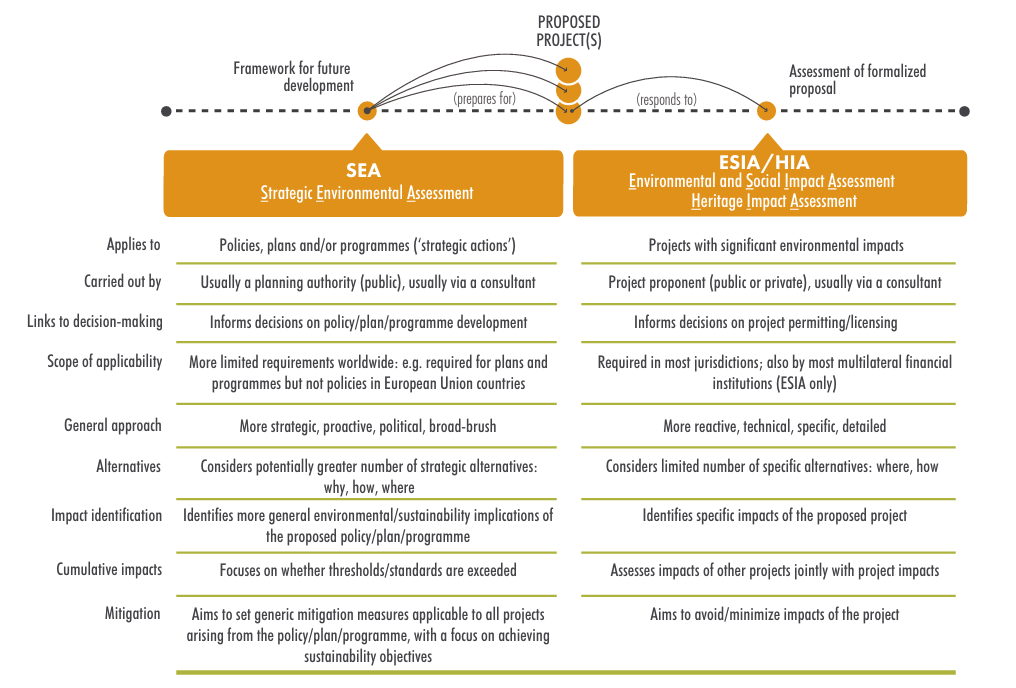
Building upon the two earlier guidance documents, the new Guidance integrates and enhances existing approaches, providing both a conceptual framework and practical procedures for impact assessments in the World Heritage context. It applies to different types of heritage (cultural, natural, and mixed) and to projects of various scales. According to the Guidance, World Heritage impact assessment can be integrated into Environmental and Social Impact Assessment (ESIA), or conducted as a standalone Heritage Impact Assessment (HIA). The Guidance can serve as a foundational textbook for capacity-building activities or for self-study. Together with the Operational Guidelines, this Guideline assists States Parties in effectively implementing the World Heritage Convention.
Differences between SEA and ESIA
Key Updates
The updated Guidance includes the following key features:
(1) It calls for incorporating HIA into national legal frameworks and management systems, making it a key tool for achieving sustainable development at heritage sites. Impact assessment can be undertaken either as part of broader ESIA or as standalone assessments focusing on OUV. Recommendations from the impact assessment shall serve as a basis for management decision-making. By drawing on existing management frameworks and processes, they contribute to improved management, monitoring, and risk mitigation, while also providing feedback for the enhancement of future impact assessments.
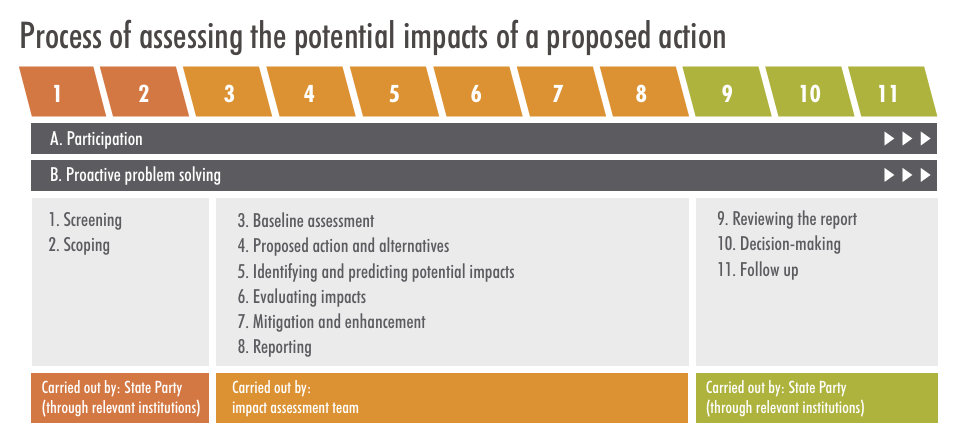
Process of Assessing the Potential Impacts of A Proposed Action
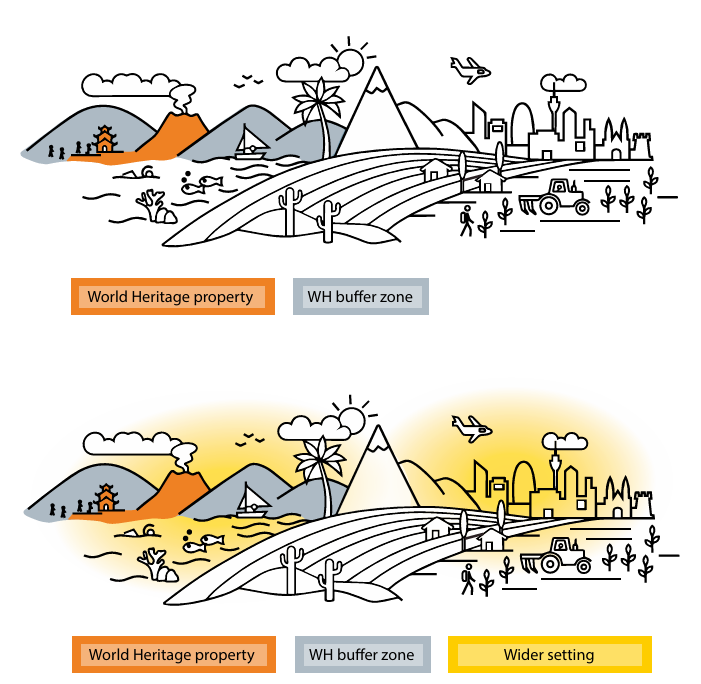
(2) It better defines the scope of heritage management and influencing factors. World Heritage boundaries comprise the property and the buffer zone. Each heritage site is surrounded by its wider setting, which collectively contributes to its significance and uniqueness. The wider setting may also play a crucial role in safeguarding the authenticity and integrity of the heritage site, and its management requires full consideration of its relationship with OUV.
Diagram of the interdependencies between the World Heritage property (orange), buffer zone (grey), and its wider setting (yellow).
(3) Impact assessments may be triggered by policies, plans, programmes, or projects. Screening and scoping should consider the entire lifecycle of proposed actions.
The entire lifecycle of proposed actions should be considered, as impacts on OUV may occur at any stage.
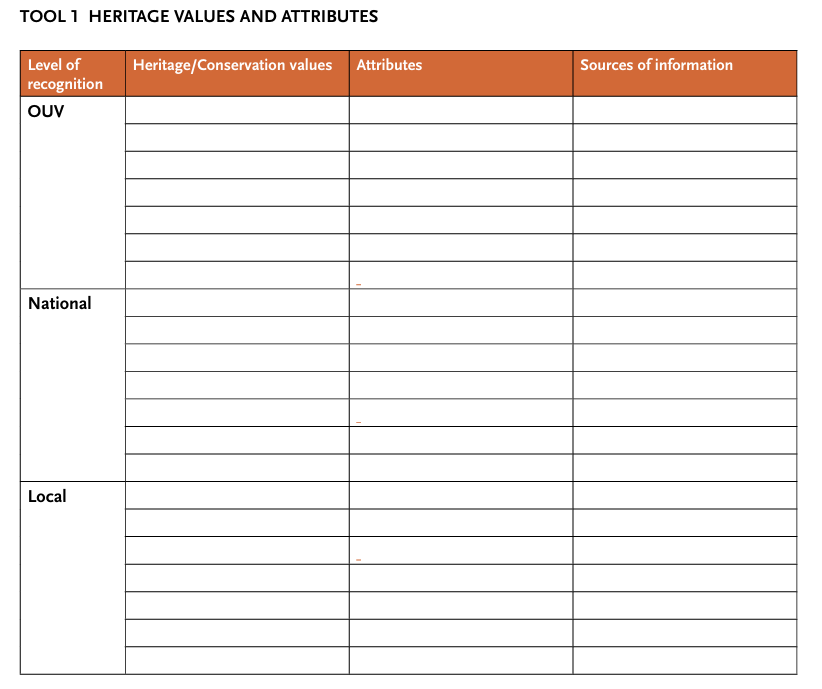
(4) Relevant contents have been integrated and updated, emphasizing the assessment principle based on "OUV and other heritage/conservation values". On the basis of OUV, Tool 1 in the Appendices to this Guideline details the steps for analyzing and decomposing heritage/conservation values.
Tool 1: Heritage values and attributes
Structure of the Guidance
The Guidance consists of six chapters and appendices. It outlines the fundamental principles and the World Heritage system, explains the procedures for conducting impact assessments in a world heritage context, and provides a glossary, a toolkit, and practical checklists for implementation. Chapter 1: Introduction Background, necessity, and structure of the Guidance
Chapter 2: Principles Fundamental principles of impact assessment
Chapter 3: The World Heritage Context for Impact Assessment Key concepts related to World Heritage
Chapter 4: Impact Assessment for World Heritage Necessity and different types of impact assessment
Chapter 5: Assessing Impacts on World Heritage as Part of a Wider Environmental and Social Impact Assessment Circumstances under which impact assessments are required under national or other frameworks, integrating World Heritage-related requirements into consideration.
Chapter 6: Stand-alone Assessment of Impacts on Outstanding Universal Value Process and procedures for conducting a World Heritage-specific impact assessment where a proposed action is likely to have potential effects on a World Heritage property.
Appendices: Tools that serve as generic templates illustrating one of many possible approaches, and can be further adapted and refined according to actual conditions.
Contributed by Zhang Tian Designed by Xv Yongxi (Intern) Ding Weiyun (Intern) Translated by Xia Ziying (Intern) Web typeset by Zhang Yidan (Intern) Edited by Liu Zhen Reviewed by Shao Yong |


- Preview丨2026 HeritAP Chat on WH Contribution to SDGs Knowledge & Skills
- 2026 Call for Applications | Young Masters for Heritage Conservation
- News| Growing Up in Pingyao Named to the 100 Best Books of the 13th “New Reading China Children‘s Book List” (2025)
- News | First Session of UHC-HEI Steering Committee
- News | The Secretariat of Our Center Visits UNESCO Category 2 Centres INRULED and CRIHAPUNESCO
- Review | A Broader View on Cultural Heritage: How to Include Both Intangible and Tangible Heritage When Documenting a Site




Copyright © 2009-2026 World Heritage Institute of Training and Research for the Asia and the Pacific Region