
| Fujian Tulou is successfully inscribed in the World Heritage List as Cultural World Heritage |
| PublishDate:2008-07-07 Hits:4297 |
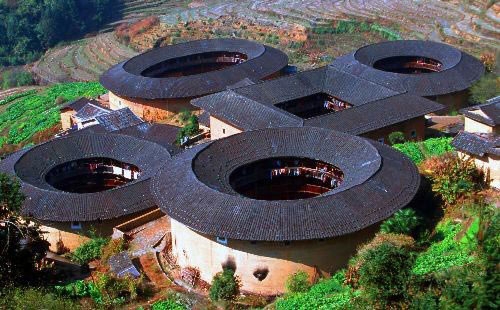 Fujian Tulou 6:30pm Quebec time, Fujian Tulou is inscribed in the World Heritage List as a cultural World Heritage site with Outstanding Universal Values. It rises up the number of Chinese properties in World Heritage List to 36. The property locates in lush mountainous areas in the south-west of Fujian province, inland from the Taiwan Strait. It contains large fortified communal clan houses, mostly built of rammed earth, and known as tulou (earthen houses), which are set amongst fields of rice, tea and tobacco below surrounding subtropical forest of pine, Chinese fir, cypress and camphor trees. Tulou (or earthen houses) are very large scale communal houses, built for defense around a central open courtyard and with few windows to the outside and only one entrance. Often up to five storeys high, their tall fortified mud walls are capped by tiled roofs with wide overhanging eaves. Housing a whole clan, which could have as many as 800 people and up to four generations, they functioned as village units and were known as a 'little kingdom for the family' or 'bustling small city'. (information from WHC documents WHC32com/inf8B1) |


- News | Secretary-General of the WHITR-AP and Delegation from the Suzhou Sub-Centre Visit the UNESCO World Heritage Centre
- News | 2026 HeritAP Chat on World Heritage Contribution to SDGs Knowledge & Skills
- News|Executive Vice President Lyu Peiming Meets with UNESCO External Evaluation Expert
- News | UNESCO Office in Hanoi and WHITR-AP Shanghai Hold Bilateral Cooperation
- Preview丨2026 HeritAP Chat on WH Contribution to SDGs Knowledge & Skills
- 2026 Call for Applications | Young Masters for Heritage Conservation


Copyright © 2009-2026 World Heritage Institute of Training and Research for the Asia and the Pacific Region