
| News|WHITR‑AP Advocates for Integrating World Heritage into Sustainable Development at the 2026 ECOSOC High-Level Political Forum |
| PublishDate:2026-07-16 Hits:19 |
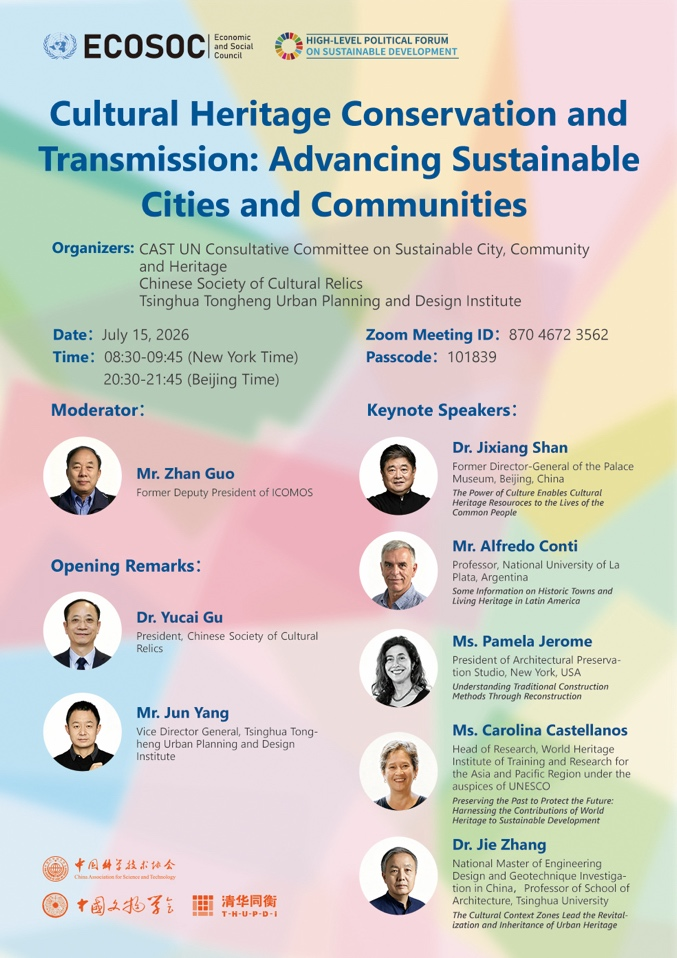 On July 15, 2026, Ms. Carolina Castellanos, Head of Research at WHITR‑AP Shanghai, delivered a keynote speech at a virtual side event of the 2026 HLPF of ECOSOC. The event titled “Cultural Heritage Conservation and Transmission: Advancing Sustainable Cities and Communities”. It was jointly organized by the CAST UN Consultative Committee on Sustainable City, Community and Heritage, the Chinese Society of Cultural Relics, and Tsinghua Tongheng Urban Planning and Design Institute.
The presentation, “Preserving the Past to Protect the Future: Harnessing World Heritage for Sustainable Development”, argued that World Heritage is a powerful tool for addressing poverty, climate change, and inequality, not a luxury to be preserved after development challenges were solved. She discussed how World Heritage properties, though covering less than 1% of Earth’s surface, are vital for employment, sustainable investment, and climate change mitigation and also foster social cohesion and biodiversity protection. However, World Heritage is underutilized in achieving Sustainable Development Goals (SDGs) and remains largely absent from the core workstreams of ECOSOC and the HLPF. The WH Convention and the 2030 Agenda share the same spirit: intergenerational responsibility, integrated action, and partnership. The 2015 policy document on WH and Sustainable Development provides a framework. What is needed is political will and institutional alignment.
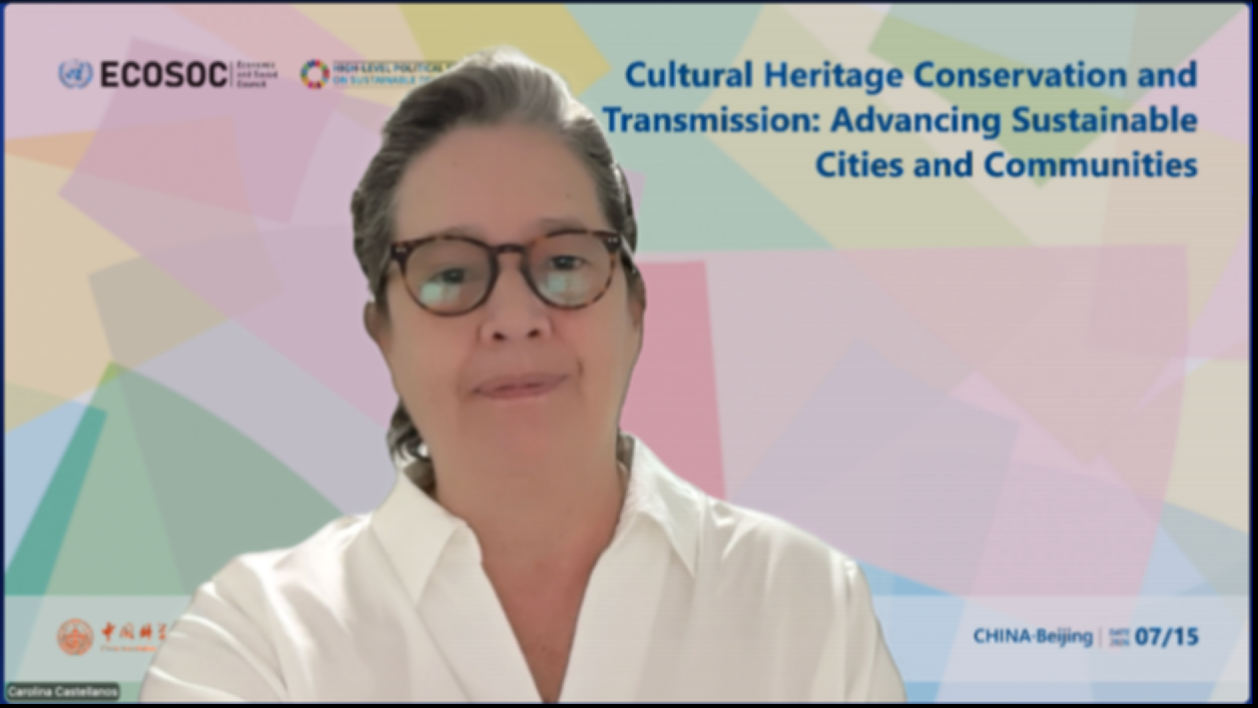 Three concrete actions were proposed: Integrate World Heritage contributions into Voluntary National Reviews (VNRs) and national development planning and recognize them as contributors to the SDGs. Leverage properties for climate adaptation, biodiversity conservation, and disaster risk reduction, to bridge the gap between heritage conservation and climate finance and ensure properties receive the investment needed to generate globally replicable solutions. Promote community-led governance and Indigenous knowledge systems as a cross-cutting standard for World Heritage management to elevate community-led heritage governance from a niche practice to a mainstream model for inclusive, peaceful, and resilient societies. Ms. Carolina Castellanos concluded by emphasizing that, “World Heritage is a dynamic asset for the future, not a passive inheritance. Preserving it is a pathway to lasting, equitable, and dignified development.”
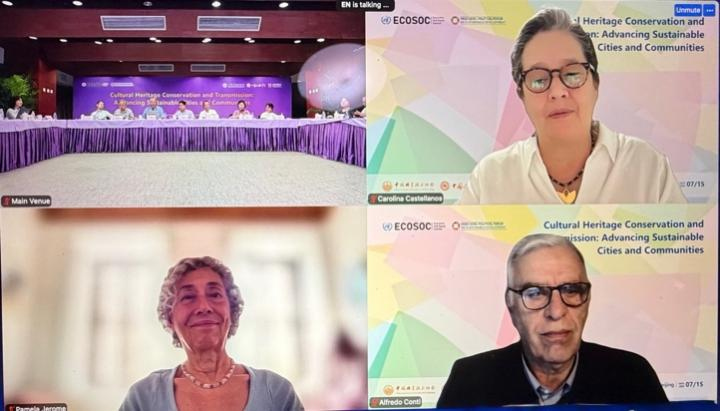 Mr. Zhan Guo, the former Deputy President of ICOMOS, moderated the side event. Mr. Yucai Gu, President of the Chinese Society of Cultural Relics, and Mr. Jun Yang, Vice Director General of the Tsinghua Tongheng Urban Planning and Design Institute, delivered opening remarks. Other keynote speakers included Mr. Jixiang Shan, former Director-General of the Palace Museum in Beijing, who spoke about the work being done in China to integrate planning and development, particularly in rural contexts. Mr. Alfredo Conti, Professor at the National University of La Plata in Argentina, discussed the challenges of gentrification and musealization at World Heritage sites, highlighting the importance of preserving traditional knowledge, practices and livelihoods. Ms. Pamela Jerome, President of the Architectural Preservation Studio in New York, presented several cases of recovery of traditional construction techniques for the reconstruction of heritage sites and the questions of how these practices can impact integrity and authenticity. Mr. Jie Zhang, Professor at Tsinghua University, discussed the case of Jingdezhen and how heritage-led development has generated tangible and intangible benefits and promoted creative industries and enhanced traditional practices for porcelain making. The session was closed by Zhan Guo who provided a summary of presentations and key issues raised.
About ECOSOC and the HLPF
ECOSOC, one of the UN’s six principal organs, coordinates international cooperation in economic, social, cultural, educational, and health fields. Established in 1945, it plays a central role in the UN’s work on Sustainable Development. The High-Level Political Forum (HLPF), the UN’s primary platform for Sustainable Development, reviews the implementation of the 2030 Agenda and its Sustainable Development Goals (SDGs).
The High-Level Political Forum (HLPF), convened annually, brings together ministers, officials, UN agencies, academics, and major groups to assess progress. The 14th session, held from July 7th to 15th, 2026, focused on the theme “Transformative, equitable, innovative, and coordinated actions for the 2030 Agenda and its Sustainable Development Goals (SDGs) for a sustainable future”. It reviewed the following SDGs: 6 (Clean Water and Sanitation), 7 (Affordable and Clean Energy), 9 (Industry, Innovation, and Infrastructure), 11 (Sustainable Cities and Communities), and 17 (Partnerships for the Goals).
Contributed by Carolina Castellanos |
|
|


- News|WHITR‑AP Advocates for Integrating World Heritage into Sustainable Development at the 2026 ECOSOC High-Level Political Forum
- Preview | Revitalizing Historic Urban and Rural Landscapes through Heritage-based Solutions: Lessons from Langtou, China
- News | Secretary-General of the WHITR-AP and Delegation from the Suzhou Sub-Centre Visit the UNESCO World Heritage Centre
- News | 2026 HeritAP Chat on World Heritage Contribution to SDGs Knowledge & Skills
- News|Executive Vice President Lyu Peiming Meets with UNESCO External Evaluation Expert
- News | UNESCO Office in Hanoi and WHITR-AP Shanghai Hold Bilateral Cooperation


Copyright © 2009-2026 World Heritage Institute of Training and Research for the Asia and the Pacific Region